Schooling for Restraint: Why Japan-China tensions now require an education-first strategy

Input
Modified
Japan–China tensions are now a social problem; deterrence alone cannot steady the region
Dedicate a sliver of rising defense spend to history education, exchanges, and crisis literacy
Pair hard power with hard learning so classrooms absorb shocks instead of amplifying them
Nearly nine in ten people in both countries view the other negatively. In 2024, 87.7 percent of Chinese respondents reported a poor impression of Japan. The same sentiment holds in Japan, where nearly 9 in 10 hold unfavorable views of China. This level of mutual distrust is not just a passing trend; it is a social reality. It influences which universities young people choose, how families discuss the region at home, and what leaders can propose to voters when talking about defense budgets. Japan-China tensions impact classrooms and living rooms just as much as they do the East China Sea. The central policy error is thinking that deterrence alone will solve the issue. If the public mood hardens, a single mistake could quickly escalate, given the climate of expectation. Education policy must be part of the response strategy.
Japan's new political direction has raised the stakes. Prime Minister Sanae Takaichi aims to achieve the 2 percent of GDP defense goal ahead of schedule and has indicated a firmer stance on any Taiwan-related issues. These moves received strong early support. A Sankei-FNN poll in late November showed cabinet approval at 75.2 percent. A Kyodo survey indicated public support for increasing defense spending, even as voters expressed mixed feelings about joining U.S. operations if China attacked Taiwan. This strategy resonates at home because it reflects public sentiment. However, success domestically could increase risks internationally. To prevent this, the policy must broaden its focus. The issue isn't just about missiles; it's whether schools, universities, and cultural exchanges can help reduce the societal impacts of a rivalry that trains the next generation to see each other as enemies.
Japan-China tensions as a domestic political asset
Domestic politics respond to clear signals. Tokyo's defense budget increased from about $34.6 billion in FY2022 to a record $55.7 billion in FY2025, marking the third year of a five-year buildup. Takaichi has expedited the timeline to reach 2 percent of GDP by combining the central budget with additional funds. These actions send a clear message to voters: the government is prepared. They also communicate directly with Beijing: Japan is serious about strengthening its military. This dual message has resulted in political support, as reflected in the new cabinet's approval ratings. Yet domestic successes can limit options in times of crisis. The more policies rely on Japan-China tensions for clarity, the more both publics believe that only force will be effective.

Polling reveals this paradox. In mid-November, 60.4% supported accelerating defense spending. Still, public opinion was almost evenly split on whether to fight alongside the United States in a potential conflict over Taiwan. Approval of the cabinet still increased. The message is clear: voters are willing to fund deterrence, yet fear the consequences of war. This is where education can play a vital role. If citizens can envision practical alternatives and a future of managed competition, leaders can express firmness without committing to escalation. If they can't, such discussions may become traps. Japan-China tensions could then evolve into a self-fulfilling cycle in which every precaution is perceived as provocative.
Japan-China tensions and the new regional map
The crisis involves more than just two countries; it's a complex situation. Japan's new security pact with the Philippines took effect in September 2025, strengthening ties from the Korean Peninsula to the South China Sea. South Korean public opinion toward Japan has also shifted rapidly, crossing a significant threshold in 2025 where favorable views exceeded unfavorable ones for the first time since the survey began. These regional shifts can foster cooperation, reassuring security analysts and officials. Beijing's selective education efforts can stabilize the region and reduce tensions.
External pressures have intensified. China's People’s Daily urged Washington to “rein in” Tokyo following Takaichi. Reports indicate that President Donald Trump spoke to Takaichi Sakaichi to avoid escalating tensions in a call after his conversation with Xi Jinping. Meanwhile, ongoing global polls reveal that China continues to have a largely negative image in many countries, despite a slight increase in favorability in 2025. This context matters. It strengthens the motivation of elites to interpret every action as a show of determination. It also heightens the risk that a single incident involving coast guard actions or airspace overlaps could ignite a larger conflict, as domestic audiences have been conditioned to anticipate it.
Educating against escalation
The social costs are becoming evident. Shortly after China issued travel and study warnings, airlines offered mass refunds, and analysts estimated around half a million tickets for travel to Japan were canceled. Tourism stocks dropped. Film releases were postponed. Universities halted exchanges. This is not soft power discussed in academic circles; it represents the large-scale breakdown of everyday connections. Japan-China tensions shut down potential avenues for building trust. When students lack opportunities to meet, myths flourish. When educators avoid challenging topics, rumors and resentment take their place. This is how societies can unknowingly slip into conflicts that no one intends.
Education systems can act now without waiting for grand agreements. Schools in Japan, China, and South Korea can introduce students to diverse historical perspectives rather than a single approved narrative. Teachers can compare textbook accounts of the same events and help students learn to recognize bias. Universities can develop joint courses that can continue online if travel is disrupted. Ministries can allocate funds for language programs and exchange scholarships that extend beyond individual budget cycles. This proactive approach offers hope that fostering understanding can prevent conflicts from escalating, encouraging policymakers and educators to see their actions as impactful.
A policy contract for cool heads
Budgets reflect beliefs. Suppose Japan can increase its core defense spending to $55.7 billion. In that case, it can allocate a portion of that increase to strengthen societal foundations: grants for history education, secured exchange programs, and crisis-awareness initiatives in schools and community colleges. Allies should also invest in this approach. Washington, Seoul, and Manila could integrate education and information resilience into official statements, alongside military agreements. They could fund collaborative language programs, cross-border teacher training, and classroom simulations that demonstrate how to balance deterrence with diplomacy. The test is straightforward: as defense efforts increase, do connections and understanding rise as well? If they don't, the strategy is incomplete.
Policy also requires room for flexibility at the top. Beijing's media will continue to portray Japan's actions as a return to militarism. Beijing will maintain that Japan validates its accelerated approach. The United States will treat both parties engaged while considering its own domestic situation. This dynamic will fluctuate between tension and calm. A social infrastructure of dialogue can help prevent this back-and-forth from becoming destructive. That represents the proper “dual-track” strategy: strong defense paired with deep learning for restraint. This approach is less costly than a crisis and more dependable than a tweet. It allows leaders to de-escalate without appearing weak.
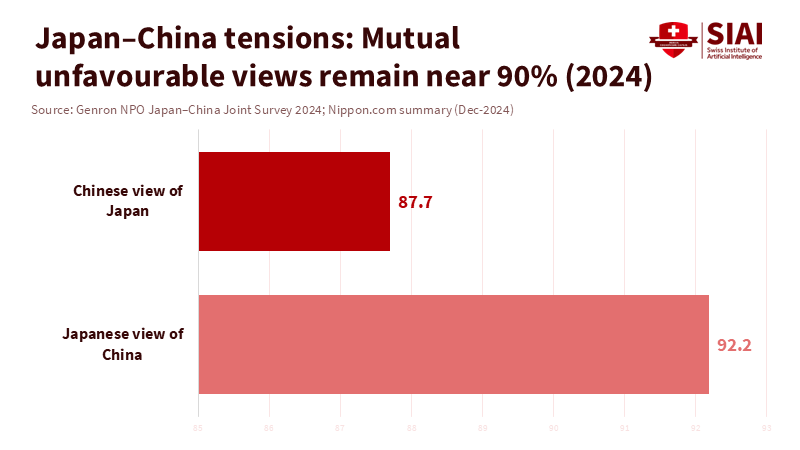
Japan-China tensions are not disappearing. They have become a constant backdrop in the region. Leaders should focus not only on numbers and military assets but also on sentiment—nearly 9 in 10 citizens on each side expect the worst from the other. This mindset can lead to escalation by default, but it can also be changed. Prioritize education as a key component of stability. Fund it as seriously as hardware. Shield it from immediate political outrage. Establish long-term programs for exchange and critical history studies, ensuring that a single diplomatic crisis doesn’t eliminate a whole generation's chance to connect. The region has ended the century-long cycle of grievance. The next decade will be determined by what students learn about both, and by whether they engage, debate, and disagree in ways that keep the door open. That approach, rather than a rhetorical victory at a press conference, is essential to preventing a rivalry from escalating into war.
The views expressed in this article are those of the author(s) and do not necessarily reflect the official position of the Swiss Institute of Artificial Intelligence (SIAI) or its affiliates.
References
Al Jazeera. (2025, November 15). China issues travel warning for Japan over threats to intervene in Taiwan.
Business Traveller. (2025, November 25). Chinese travelers cancel Japan flights amid rising tensions.
DefenseNews. (2025, January 16). Japan passes record defense budget, while still playing catch-up.
East Asia Forum. (2025, November 26). Uncertainties trail behind Takaichi’s strong start.
East Asia Forum. (2025, November 27). Takaichi’s Japan enters an era of fragile coalitions.
Embassy of Japan in the Philippines. (2025, August 12). Exchange of diplomatic notes for entry into force of the Japan-Philippines Reciprocal Access Agreement.
Genron NPO & China International Publishing Group. (2024). Japan–China joint public opinion survey 2024 (PDF).
Japan Forward / Sankei–FNN. (2025, November 25). Takaichi's approval remains high at 75%.
Ministry of Defense, Japan. (2025, April 11). Progress and budget in fundamental reinforcement of defense capabilities (FY2025 overview) (PDF).
Nippon.com. (2024, December 27). Chinese views of Japan deteriorate in 2024.
Pew Research Center. (2025, July 15). International views of China turn slightly more positive.
Reuters. (2025, November 16). Japanese divided on military response to China over Taiwan, Kyodo poll shows.
Reuters. (2025, November 27). China’s top paper urges U.S. to rein in Japan over Taiwan.
Reuters. (2025, November 27). Trump urged Japan’s PM to avoid escalation in China dispute, sources say.
The Diplomat. (2021, December 27). Japan approves record defense budget for FY2022 (¥5.4 trillion).
The Japan Times. (2024, April 29). Japan ups defense spending to 1.6% of GDP.
East Asia Institute. (2025, June 23). 2025 EAI public opinion poll on East Asia (press brief; favorable views of Japan 63.3%).




















Comment